
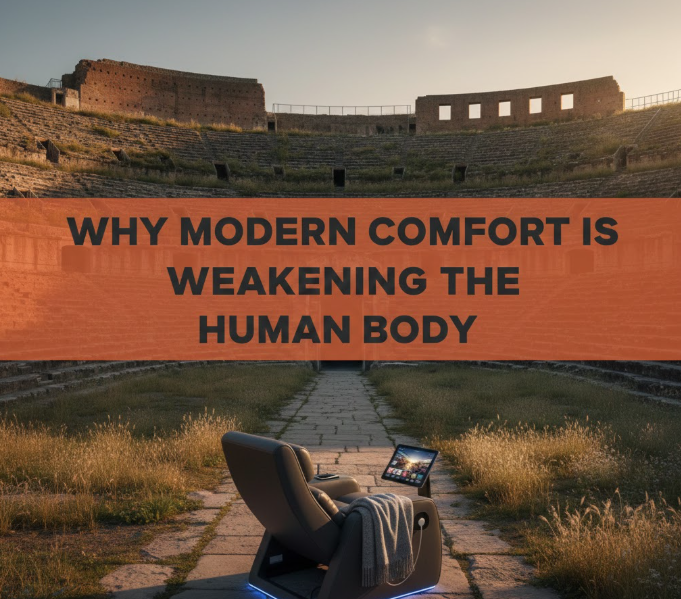
Introduction: The Comfort Trap We’ve Built
Picture your great-grandparents. They walked miles to school, chopped wood for heat, and carried water from wells. Now picture yourself. You probably drove to get coffee this morning, adjusted the thermostat from your phone, and had groceries delivered to your door.
Life has never been easier. But here’s the uncomfortable truth: all this comfort comes with a hidden price tag. Our bodies are getting weaker, our immune systems less robust, and our tolerance for discomfort dangerously low.
The human body evolved over millions of years to handle physical challenges. We walked long distances, lifted heavy objects, endured temperature extremes, and pushed our limits daily. Modern life has removed nearly all these challenges. The result? We’re living in the most comfortable era in history, yet facing unprecedented health crises.
This article explores how modern convenience is systematically weakening our bodies and what we can do to fight back against this trend.
The Sitting Disease: How Chairs Became Our Enemy
Your Body Wasn’t Built for Sitting
Humans spent most of evolutionary history on their feet. Our ancestors walked an average of 5-10 miles daily just to survive. They squatted, climbed, and moved constantly.
Today, the average American sits for 6-8 hours daily. Office workers can hit 10-15 hours when you include commuting and evening screen time.
Sitting for extended periods triggers a cascade of problems:
- Your hip flexors tighten and shorten
- Glute muscles essentially shut down
- Core muscles weaken from lack of engagement
- Blood flow to legs decreases significantly
- Metabolism slows by up to 90%
Researchers now call prolonged sitting “the new smoking” because the health risks are so severe.
The Muscle Memory We’re Losing
Your body adapts to what you demand from it. When you sit all day, your body thinks that’s the new normal. It starts breaking down muscle tissue you don’t use and weakening bones that aren’t bearing weight.
Studies show that office workers lose muscle mass 3-5 times faster than people with physically active jobs. By age 50, sedentary adults have lost 10-15% of their muscle mass. By 70, that number jumps to 30%.
This isn’t just about looking fit. Muscle mass directly affects metabolism, bone density, balance, and even cognitive function.
Climate Control: The Temperature Challenge We’ve Eliminated
Why Sweating and Shivering Matter
Your ancestors didn’t have air conditioning or central heating. They dealt with scorching summers and freezing winters. Their bodies had to work hard to maintain core temperature.
This constant temperature regulation built metabolic resilience. When you’re exposed to heat, your body increases blood flow, improves cardiovascular function, and activates heat shock proteins that protect cells. Cold exposure triggers brown fat activation, which burns calories to generate heat.
Modern climate control has eliminated this daily workout for your metabolism.
The Thermostat Effect on Immunity
Research shows that people who live in perfectly climate-controlled environments have weaker immune responses. Temperature variation actually strengthens immune function.
A Finnish study found that people who regularly used saunas had 30% fewer respiratory infections. Another study on cold exposure showed increased white blood cell counts and improved immune markers.
By keeping our environment at a constant 72 degrees, we’re essentially putting our immune system on easy mode. When challenge arrives, we’re unprepared.
Technology’s Physical Toll
The Smartphone Posture Problem
Look around any public space. Heads are down, shoulders rounded, necks craned forward. Doctors now diagnose “text neck” in teenagers.
The average human head weighs 10-12 pounds. When you tilt it forward 60 degrees to look at your phone, the effective weight on your spine increases to 60 pounds. That’s like carrying an 8-year-old child on your neck for hours daily.
This chronic poor posture leads to:
- Herniated discs in young adults
- Chronic neck and shoulder pain
- Reduced lung capacity from compressed chest
- Headaches and jaw problems
- Permanent spinal changes
The Grip Strength Crisis
Grip strength is a surprising indicator of overall health. Researchers use it to predict cardiovascular disease, disability, and even mortality.
Studies comparing grip strength across generations show alarming declines. Millennials have significantly weaker grip strength than their parents did at the same age. The culprit? Less manual labor and physical activity.
We no longer open jars by hand, turn manual can openers, or do yard work without power tools. Our hands and forearms are dramatically weaker than previous generations.
The Convenience Food Factor
How Processed Food Weakens More Than Just Waistlines
Modern food production has made eating effortless. You don’t hunt, gather, grow, or even cook. You order, heat, and eat.
This dietary shift affects more than just nutrition. Traditional diets required significant jaw work. Tough meats, raw vegetables, and whole grains built strong jaw muscles and promoted proper facial development.
Orthodontists now see epidemic levels of crowded teeth and underdeveloped jaws in children. The soft, processed modern diet doesn’t provide enough resistance to stimulate proper bone growth.
The Gut Health Connection
Your digestive system is a muscle. Like any muscle, it needs exercise. Traditional diets high in fiber and whole foods kept digestive muscles strong.
Processed foods are pre-digested by manufacturing. Your gut barely has to work. Over time, this leads to weakened digestive function, slower motility, and increased sensitivity.
Ultra-processed foods now make up 60% of the average American diet. This represents a complete departure from the foods that built strong human bodies for millennia.
The Exercise Paradox
Why Gym Memberships Don’t Solve the Problem
Here’s something counterintuitive: gym attendance is at an all-time high, yet physical weakness is increasing.
The issue isn’t that people don’t exercise. It’s that one hour at the gym can’t compensate for 15 hours of inactivity. Your body needs constant, varied movement throughout the day, not intense bursts followed by prolonged stillness.
Traditional lifestyles incorporated movement into everything. Walking for transportation, manual labor for work, active recreation. Movement wasn’t separate from life—it was life.
The Functional Movement Gap
Modern exercise often focuses on isolation. Bicep curls, leg extensions, chest presses. These movements don’t exist in nature.
Your ancestors never did bicep curls. They climbed, carried, pulled, and pushed real objects in unpredictable environments. This built comprehensive strength, balance, and coordination.
Today’s specialized exercise creates specialized strength. You might bench press 200 pounds but struggle to carry awkward objects or maintain balance on uneven ground.
Sleep Technology and Weakness
The Blue Light Problem
Artificial light, especially blue light from screens, disrupts circadian rhythms. Your body’s internal clock evolved to respond to natural light cycles.
When you expose yourself to bright screens at night, your brain thinks it’s daytime. Melatonin production drops. Sleep quality plummets.
Poor sleep directly impacts physical strength. Growth hormone, which repairs and builds muscle, releases primarily during deep sleep. Chronic sleep disruption means chronic recovery problems.
The Over-Engineered Sleep Environment
Memory foam mattresses, weighted blankets, white noise machines, blackout curtains—we’ve created cocoon-like sleep environments.
While comfortable, this removes natural adaptability. Your ancestors slept on relatively firm surfaces in less-than-perfect conditions. Their bodies adapted and became resilient.
People who rely heavily on specific sleep conditions often struggle with travel, stress, or environmental changes. Physical resilience includes the ability to rest under various circumstances.
The Data Behind Physical Decline
Strength Standards Across Generations
| Generation | Average Grip Strength (Men) | Average Grip Strength (Women) | Physical Activity Level |
|---|---|---|---|
| Pre-1950 | 115-120 lbs | 70-75 lbs | High (Manual labor common) |
| Baby Boomers | 110-115 lbs | 68-72 lbs | Moderate |
| Gen X | 105-110 lbs | 65-68 lbs | Moderate-Low |
| Millennials | 98-105 lbs | 60-65 lbs | Low |
| Gen Z | 95-100 lbs | 58-62 lbs | Very Low |
Data compiled from multiple longitudinal studies on grip strength measurements
The Mobility Crisis in Numbers
- 80% of adults will experience back pain
- 50% of people over 50 cannot do a bodyweight squat
- 70% of children cannot complete 10 pushups
- Average person walks 65% less than in 1965
- Bone density in young adults is 5-10% lower than in previous generations
These numbers paint a clear picture. Each generation is physically weaker than the last.
The Immunity and Resilience Connection
The Hygiene Hypothesis
Modern cleanliness has benefits, but we’ve taken it too far. Antibacterial everything, sanitized surfaces, minimal outdoor exposure—all this reduces immune system training.
Your immune system needs exposure to build strength. Children who grow up on farms have significantly lower allergy and asthma rates. Playing in dirt isn’t dirty—it’s essential immune system education.
Temperature Resilience and Metabolic Health
People who regularly experience temperature variation show improved metabolic markers:
- Better insulin sensitivity
- Increased brown fat activation
- Improved cardiovascular function
- Enhanced stress response systems
By maintaining constant comfort, we’re weakening our bodies’ ability to adapt and respond to challenges.
Breaking Free From the Comfort Trap
Simple Changes With Big Impact
You don’t need to abandon modern life. Small adjustments can rebuild physical resilience:
Movement Integration:
- Stand or walk during phone calls
- Take stairs instead of elevators
- Park farther away from entrances
- Do household chores manually
- Walk or bike for short trips
Temperature Variation:
- End showers with 30 seconds of cold water
- Keep your home slightly cooler in winter
- Spend time outdoors in various weather
- Try contrast therapy (alternating hot and cold)
Functional Fitness:
- Carry groceries instead of using carts
- Do yard work without power tools
- Play active games with family
- Practice squatting and ground movements
- Lift and move real objects regularly
The Progressive Exposure Approach
Don’t shock your system. Build resilience gradually.
Start with five minutes of discomfort daily. Cold showers for 30 seconds. Walking barefoot on textured surfaces. Sitting on the floor instead of furniture. Carrying groceries in your arms.
Add challenges weekly. Your body will adapt and strengthen. Within months, you’ll notice improved energy, better posture, increased strength, and enhanced resilience.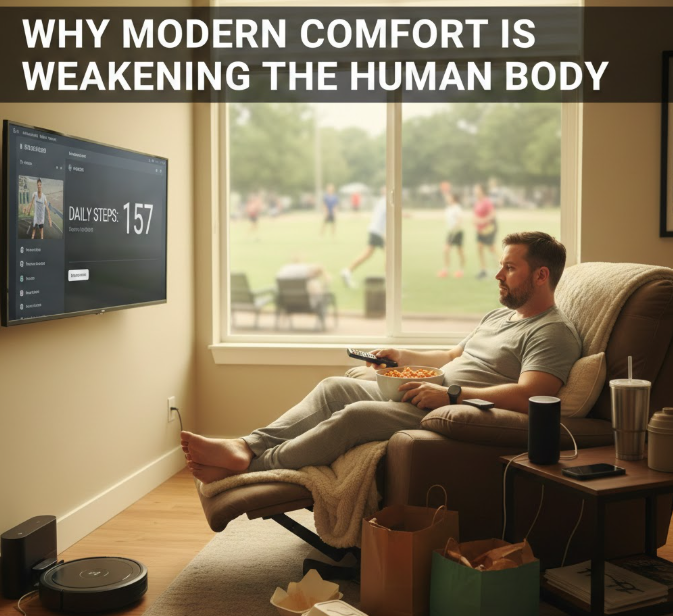
The Mental Strength Connection
Physical and mental strength are inseparable. When you eliminate physical challenges, you also eliminate opportunities to build mental toughness.
Pushing through discomfort teaches perseverance. Lifting heavy objects builds confidence. Enduring temperature extremes develops discipline. These lessons transfer to every area of life.
Modern comfort doesn’t just weaken bodies—it weakens character. We’re raising generations that struggle with any form of difficulty because they’ve never had to overcome physical challenges.
Frequently Asked Questions
Is modern comfort really making us weaker, or are we just less active?
Both factors work together. Modern comfort enables inactivity by removing physical challenges from daily life. Previous generations had to move to survive. Today, you can live entirely from your couch. The comfort creates the conditions for weakness.
Can you reverse physical weakness caused by modern lifestyle?
Absolutely. The human body is remarkably adaptable. Most people see significant improvements within 3-6 months of increasing daily movement, adding strength training, and incorporating environmental challenges. Younger individuals respond faster, but improvement occurs at any age.
How much daily movement do we actually need?
Research suggests 8,000-10,000 steps daily plus 2-3 strength training sessions weekly. However, movement quality matters more than quantity. Varied, functional movements throughout the day beat isolated exercise followed by prolonged sitting.
Are standing desks enough to combat sitting weakness?
Standing desks help but aren’t complete solutions. Standing still for hours creates different problems like foot pain and varicose veins. The ideal approach combines sitting, standing, and walking throughout the day with frequent position changes.
Should I feel guilty about enjoying modern comforts?
Guilt isn’t productive. Instead, practice intentional discomfort. Enjoy air conditioning, but also spend time outside. Use your car, but also walk regularly. Balance comfort with challenge to maintain physical resilience while enjoying modern conveniences.
At what age does physical decline from comfort become irreversible?
It’s never truly irreversible. People in their 70s and 80s can rebuild significant strength and function. However, prevention is easier than reversal. Starting strength-building habits younger makes maintaining physical capacity throughout life much easier.
Conclusion: Choosing Strength in a Comfortable World
We stand at a crossroads. Technology and convenience will only increase. Every year brings new ways to eliminate physical challenge from daily life.
The question isn’t whether to reject modernity. That’s neither practical nor desirable. The question is whether we’ll consciously maintain the physical challenges that built strong human bodies for millions of years.
Your great-grandparents didn’t choose difficulty—they had no choice. You have every choice. And that makes your decision more important, not less.
Physical weakness isn’t an inevitable consequence of progress. It’s a choice we make through thousands of small decisions daily. Every time you choose the elevator, the drive, the thermostat adjustment, the food delivery, you’re choosing comfort over strength.
But you can choose differently.
Start today. Take the stairs. Carry your groceries. Walk in the cold. Sit on the floor. Lift something heavy. Your body will respond. It’s designed to adapt, strengthen, and thrive when challenged.
Modern comfort is weakening the human body—but only if we let it. The power to maintain physical resilience in a comfortable world lies entirely in your hands. Use it before it’s too late.
The strongest generation won’t be the one with the most advanced technology. It will be the one that chose challenge in the age of comfort. Which generation will yours be?