
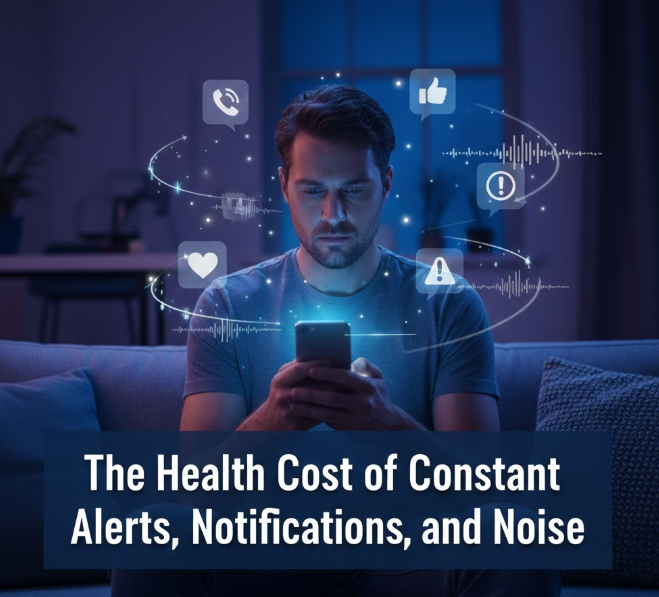
The Reason Your Phone Won’t Stop Buzzing
Your phone buzzes. You check it. Another ping is heard two minutes later. Then your computer chimes in. Your smartwatch taps your wrist. You are checking your devices a dozen times without even noticing it before you leave.
This isn’t just annoying. It is truly damaging your health contrary to your expectations.
We are in a world where we are never not being interrupted. Apps want our attention. News wants to be read immediately. Friends want immediate responses. Work emails come at any time of the day. Even our homes have machines which beep, buzz, and talk to us all day long.
The average human being gets between 60-100 notifications on an average day. Some people get even more. Each of them distracts you from what you are doing. Each of them causes a minute amount of stress in your brain. And put them all together, these little things cause great issues to your body and to your mind.
Let us find out what all these alerts, notifications, and noise are really doing to your health.
Your Brain on Permanent Interruption
Imagine your brain is like a muscle that is tired. Your brain has to struggle every time you change your focus from one thing to another. It is as though stopping a car and picking it up or simply making it roll in a straight line.
This is known as context switching by scientists. And your brain must take time to determine what it was doing prior to the interruption. Then it will take even longer time to get into the working flow once again. A research study established an average of 23 minutes to achieve a complete 100 percent refocus following an interruption.
Now multiply it by the number of times per day that you are interrupted. You start to see the problem.
The Attention Drain Problem
Your power of concentration is like a battery. It starts full in the morning. Still, every notification, alert, and noise will consume some power. By afternoon, you may be psychologically drained even when you have done little or no real work.
Your memory is also subject to this continual drain. When your brain does not get an opportunity to relax and process information in an appropriate way, it finds it hard to transfer things from short-term memory into long-term storage. You may have frequent forgetfulness or confusion over simple things.
Young people are particularly impacted. Students who have their phones close to them during study perform poorly in examinations. They take longer on homework. This compromises their grades since their brains do not get the time to concentrate on what is really needed to learn.
Your Physical Cost and Price
The health cost of constant alerts, notifications, and noise is not mental only. Your body is physically damaged as well.
Stress Hormones Go Wild
Each time you hear a notification, a small portion of cortisol is released in your body. This is your stress hormone. Cortisol in low quantities will keep you awake and alert. However, when it is flowing all day round, it is toxic.
High cortisol levels cause harm to your immune system. You get sick more often. You also have delayed healing of injuries. Your body is kept in a low-level panic which wears out your organs and systems.
Your Heart Takes a Hit
Constant alerts ensure your heart rate is a little higher. Your blood pressure remains elevated. This can predispose you to cardiovascular diseases, heart attacks, and strokes in the long run.
One study shadowed office workers over six months. The individuals with the greatest number of notifications had increased blood pressure and rapid heart rates at rest compared to those who restricted their alerts.
Sleep Gets Destroyed
This could be the most significant physical issue. Notifications are interfering with your sleep in many ways.
To start with, the blue light from screens deceives your brain into believing that it is daytime. This prevents the formation of melatonin in your body, which is the hormone that causes you to feel sleepy.
Second, looking at your phone before going to sleep is a stimulant. You may notice something stressful, exciting, or important. Your thinking is racing instead of slowing down.
Third, messages received at night wake you up or prevent deep sleep. Although you may not fully be awake, your brain registers the sound or vibration. The quality of your sleep becomes considerably low.
The lack of sleep involves a cascade effect. Weight gain. Diabetes risk. Weakened immunity. Memory problems. Mood disorders. The list goes on and on.
Noise Pollution Does More Damage than to Hearing
Another layer of health problems is caused by background noise created by traffic, construction, appliances, and technology.
The Constant Background Hum
Not many people even notice noise any longer. You become accustomed to the refrigerator humming, the air conditioner running, the traffic noise, and the devices beeping. However, these sounds never leave your brain alone.
This forms what doctors term acoustic stress. All the time, your nervous system remains partially alert. You feel anxious, and you don’t even know why. Your muscles stay tight. Your breathing becomes shallow.
Cities are particularly bad. Noise pollution in cities is directly connected to severe health problems. Heart disease, depression, and anxiety are higher among people who live in noisy neighborhoods. Children subjected to noise pollution demonstrate delayed language development and learning issues.
Noise pollution has been listed by the World Health Organization as one of the leading environmental health hazards. However, the majority of individuals do not view it as a serious issue since the harm is caused over a period of time.
Mental Health Receives a Severe Thrashing
Perhaps the most worrisome part is the psychological impact of alerts and notifications that have to be constant.
Anxiety Levels Spike
Most individuals are affected by the so-called notification anxiety. You get phantom vibrations in your pocket. You compulsively check your phone even when nothing occurred. It panics you when you are unable to locate your device.
This fear spreads to your social life as well. You fear that you are going to miss out on important messages. You feel under pressure to answer everything. You draw comparisons with other people based on likes, comments, and shares.
Young people suffer the most. The rates of teen anxiety and depression have increased dramatically after the emergence of smartphones. The relationship is evident and documented in hundreds of studies.
Depression Connections
The constant connectivity paradoxically leads to feeling more isolated. You scroll through feeds of other people’s highlight reels. In comparison, your own life seems boring. You devote greater time to screens and less time to actual human contact.
The dopamine stimulation from notifications generates addictive-like behaviors. Your brain craves the next ping, the next like, the next message. Without it, you feel empty or sad.
FOMO Becomes Real
Fear of missing out is not a funny acronym. It is a real stressor for millions of individuals. All the notifications remind you about what is going on without you. Events you weren’t invited to. Conversations in which you don’t participate. Lives that seem better than your own.
This continual comparison harms self-esteem and life satisfaction. Individuals claim to be less happy even though they are more connected than any other generation in history.
The Myth of Productivity Bites the Dust
Lots of individuals remain always connected arguing it makes them more productive. Quite to the contrary, the opposite is true.
Multitasking Is Impossible
Your brain cannot do two things at once. What you consider to be multitasking is actually a rapid process of task-switching. And each transition wastes time and mental energy.
Research indicates that individuals who attempt to multitask spend 40 percent more time accomplishing tasks. They make more mistakes. Their work quality is compromised. They are more stressed and achieve less.
Deep Work Disappears
The processes of creative thinking, problem-solving, and learning necessitate the use of long uninterrupted attention. This is almost impossible due to constant notifications.
Writers are not able to develop complex concepts. Programmers cannot solve hard problems. Students are unable to comprehend difficult concepts. All end up producing superficial work that barely scratches the surface.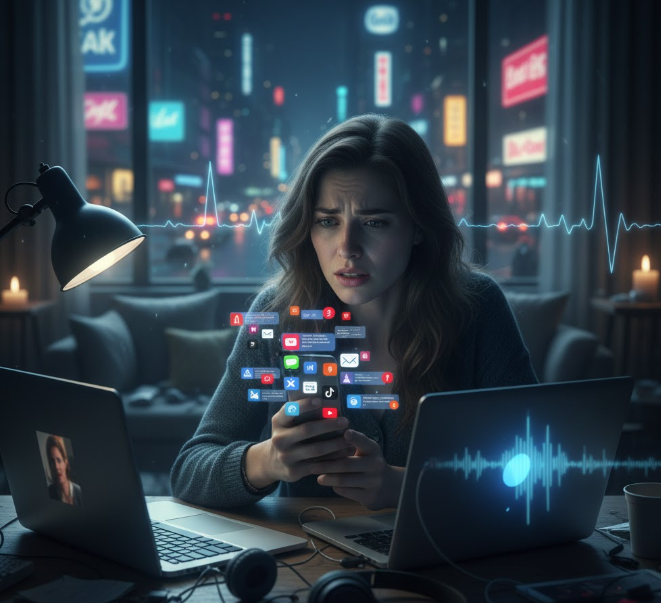
A Look at the Data
Let’s now look at a few particular figures indicating the magnitude of this problem.
| Health Impact | Statistics |
|---|---|
| Daily notifications received | 60-100 per individual |
| Time to refocus after interruption | 23 minutes average |
| Loss of sleep per night from devices | 30-60 minutes |
| Increase in teen anxiety since 2010 | 70% rise |
| Productivity loss through interruptions | 40% slower task completion |
These figures give us a definite picture. There are enormous health expenses in terms of damage to various spheres of life due to the health cost of constant alerts, notifications, and noise.
Easy Ways to Change the World
The silver lining is that you are able to be in control. Minor changes generate significant improvements in the way you feel.
Notification Management Strategies
Begin by disabling unnecessary notifications. You do not need notifications for every email, social media like, and app update. Keep only what is really important.
Apply Do Not Disturb during focus time, meals, and before sleep. Arrange regular check-ins for messages in place of responding to every ping on demand.
Get rid of notification badges on your home screen. Those red numbers create psychological pressure to check constantly.
Create Quiet Zones
Have some no-phone zones in your house. One should certainly be the bedroom. Another suitable option is the dinner table.
Wear noise-canceling headphones or use white noise machines to shut out distracting environmental noises. Simple earplugs would also help during sleep.
Keep windows open as much as you can rather than running a fan or air conditioner constantly. Natural sounds are less stressful compared to mechanical sounds.
Build Better Habits
Work or study with your phone in another room. The physical distance decreases the desire to look at it all the time.
Limit the time spent on social media rather than scrolling all day. Perhaps fifteen minutes in the morning and fifteen in the evening.
Get used to short device-free times. Start with 30 minutes. Work up to a few hours. Eventually try a full day.
Create a Better Sleep Environment
Avoid screens at least an hour before bed. The difference in sleep quality is drastic.
Charge your phone outside the bedroom. Use an old alarm clock rather than your phone.
Maximize the darkness and quiet of your bedroom. Such conditions assist your brain in generating adequate sleep hormones.
As a Parent: Focus on Establishing Healthy Technology Habits in Children
Children and adolescents require particular protection against notification overload. Their brains are still developing. The harm will be more serious and long-lasting.
Parents are expected to lead by example. Children do what they observe, not what is dictated.
Establish specific policies regarding the use of devices during homework, family time, and bedtime. These limits assist children in developing healthy habits that persist into adulthood.
Encourage activities demanding sustained attention. Reading physical books. Playing sports. Building things. Drawing or painting. These strengthen concentration muscles which are undermined by constant notifications.
Phone-free zones and times should also be developed in schools. In schools where phones are prohibited in classrooms, attention, grades, and social interaction improve immediately.
What About Work Requirements?
Most individuals are constrained by job demands to be always accessible. Even in challenging work environments, it is possible to have boundaries.
Be frank with your manager concerning notification stress. Suggest certain periods when you will be available and deep work periods that will have no distractions.
Apply status indicators on messaging apps. Signals like “In a meeting” or “Focus time” make colleagues aware of when they can expect responses.
Switch off work notifications during non-working hours. The time off you get should be real time off. Companies that observe this have more productive and happy employees.
The Road to Recovery
Reducing the health cost of constant alerts, notifications, and noise takes time. It takes weeks or months before your brain and body adapt to a less stressful environment.
At first you may feel anxious when you minimize notifications. That’s normal. It is like quitting any addictive substance.
Stick with it. The majority of individuals have said that they felt much better after only 2 weeks of decreased exposure to notifications. Better sleep. Less anxiety. Improved focus. More energy.
Your relationships also improve. You establish deeper connections when you are completely present with people rather than half-distracted by your phone. The discussions are more meaningful.
For more insights on maintaining balance in our digital age and prioritizing your wellbeing, visit Rokvia to explore additional health and wellness resources.
Frequently Asked Questions
What number of notifications per day is too many?
Above 20 notifications daily begins to influence concentration and stress levels. More than 50 has a significant effect on the mental health of most individuals.
Does notification stress have serious health outcomes?
Yes. The effects of chronic stress caused by regular alerts contribute to heart disease, high blood pressure, lowered immune system, anxiety disorders, and depression.
Are silent notifications still a problem?
Absolutely. Even silently seeing notifications produces the same mental interruption and stress response. Vibrations and visual signals trigger the release of cortisol.
How long does the process of overcoming notification addiction take?
Significant improvements in most cases are realized within 2-3 weeks of notification reduction. It takes approximately 3 months to become properly adjusted and for new habits to be established.
Is it better to get rid of social media entirely?
Not necessarily. Restricting use and switching off all notifications usually provides benefits without full deletion. However, complete breaks are beneficial to some individuals.
What about emergency notifications?
Only truly necessary alerts should be left on. Emergency notices, significant family information, and vital work information. Everything else can be checked later.
Taking Your Power Back
The human health burden of incessant alerts, notifications, and noise is real and major. But you’re not helpless. Any decrease in unnecessary interruptions makes you healthier.
Start small. Choose one of the changes in this article and apply it today. Switch off notifications on social media. Keep your phone out of the bedroom during meals. Switch on Do Not Disturb before sleep.
Such small actions result in significant health changes. Better sleep equals increased energy. Less stress equals better mood. Increased focus means greater accomplishment.
Your brain deserves rest. Your body needs calm. Your mental health must be defended against the digital world’s insatiable demands.
The world will not end because you spend 30 minutes instead of 30 seconds to reply to a message. Your value is not determined by the speed of your response to all the pings, buzzes, and beeps.
Choose quiet over chaos. Select focused availability instead of constant availability. Get back your attention from machines that are vying for it.
Your health is more valuable than anything that can ever be sent to you in the form of a notification.